




Physician, know thyself
How LBS professor Simona Botti uses brand principles to address the burnout crisis among doctors

Physicians juggle punishing workloads, long shifts, chronic understaffing issues and the emotional strain of caring for the distressed, the ill and the dying. For many this can lead to “debilitating stress” or even depression.
But the wellbeing crisis affecting doctors extends beyond the immediate demands of clinical work itself.
Evidence published by British Medical Journal and elsewhere points to “mid-career stagnation” among senior physicians – a loss of direction and professional identity that is leaving experienced clinicians untethered from values and purpose, and uncertain of their place within the systems they serve.
Early-career clinical training is identity-defining, because it is intense, rigorous and tightly structured to teach young medics to think, act and feel like a physician. As doctors progress, however, that structured support tends to fall away. Without external input or guidance, professional identity can lose its defining edges over time. It can become detached from internal beliefs, values or purpose. As a result, doctors may struggle to navigate their careers effectively, make the right personal and professional choices or career pivots, set boundaries, seize opportunities, recover from setbacks or transition into leadership roles.
“There’s no clear framework in academic medicine or clinical practice for ongoing professional identity development beyond initial training. As physicians become independent practitioners, the result is uncertainty, lack of direction and identity misalignment.”
Simona Botti
When there is a lack of understanding surrounding one’s professional identity, it has the potential to fuel affective stress and burnout, says Simona Botti.
Simona is Professor of Marketing at London Business School. She teaches the School’s Brand Management elective course and co-directs its Strategic Branding open-enrolment executive education course. One of Simona’s students, a doctor by training, took the initiative to share her Brand Management framework – a teaching tool she has devised – with fellow physicians. These colleagues were curious about how the principles of brand management might be applied to physicians’ careers as a way of understanding and managing the tension between personal and professional identity and between institutional expectations and productivity metrics.
“The idea was as novel as it was striking. Brand management offered a framework to map, manage and re-align a physician’s evolving professional identity.”
Simona Botti
Dr. Michael A. Gisondi is Professor of Emergency Medicine and Assistant Dean for Academic Advising at Stanford School of Medicine. When news of the idea reached him, he contacted Simona with a proposal: that they work together with another colleague – Jeremy Branzetti, a board-certified physician and Associate Professor of Emergency Medicine at Yale School of Medicine – to explore the possibility of understanding physicians’ professional identity through the lens of personal brand management to organised and sustain work and career direction.
“Ask most physicians who they are, and most will reflexively describe their specialty, niche, academic rank, or administrative position, but few are able to communicate their underlying professional values, beliefs, or purpose.”
Jeremy Branzetti
A transatlantic, interdisciplinary collaboration began – one that has brought the tools of marketing and brand management into the world of academic medicine, offering new ways of understanding and shaping physicians’ professional identity across the entire career lifespan.
“What makes this paper particularly interesting is that its genesis lay in teaching rather than in research. The student and his physician colleagues recognised the value of the Brand Management framework and translated it into the medical domain.”
Simona Botti
Simona’s paper is co-authored by Jeremy, Michael, and colleagues Laura Hopson of the University of Michigan Medical School and Linda Regan of Johns Hopkins University School of Medicine. It showcases the Brand Management framework as a system that sustains the meaning and coherence of identity as it evolves over time.
This framework is built around four interrelated components.
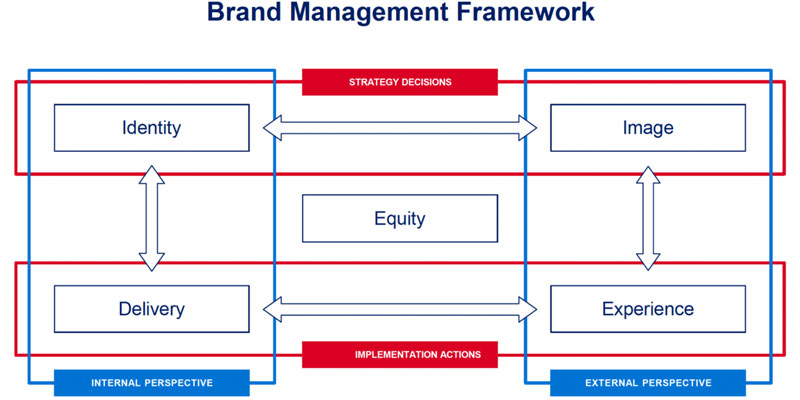
Translated into the domain of medical practice, the framework looks like this:
Professional wellbeing results from alignment across these four components. When identity and delivery are consistent, and when experience and image reflect that identity, physicians are more likely to feel purposeful, in control of their career choices, and professionally fulfilled.
One of the key ideas shared by Simona and her co-authors is that identity evolves over time. Sustaining professional fulfilment involves the conscious alignment of what physicians value with what they do and how they are perceived, supported by structured reflection as an ongoing corrective process that allows for pivoting or change when necessary. They suggest that physicians routinely perform a “brand audit” – asking themselves a set of diagnostic questions designed to test alignment, surface blind spots and pinpoint any identity drift that might contribute to stagnation or burnout.
The audit is built around four core questions:
| Scenario | |
|---|---|
| Dr. X is an assistant professor at a prestigious medical school. Over the last year, Dr. X has felt more frustrated and less fulfilled by this role. Days have felt longer, program challenges feel more grating, and achievements feel less rewarding. Dr. X has not made much progress towards promotion to associate professor rank; their chair has encouraged them to turn their residency initiatives into scholarly products, but numerous personal and professional demands keep taking priority. |
|
| Brand Identity: Who am I? | Dr. X frames their brand identity as “helping to create the future of medical education.” |
| Brand Delivery: What actions do I choose to present myself to others? | Dr. X acknowledges that their current brand delivery actions include mentoring, bedside and classroom teaching, and program director administrative responsibilities. |
| Brand Experience: How are my actions experienced by others? | Dr. X reviews their lecture evaluations, yearly faculty feedback/assessment, resident feedback, and asks relevant audiences to “describe my brand.” |
| Brand Image: How do others see me? |
|
| Alignment: Am I seen as I truly am? | Dr. X decides to make the following changes to better align their brand image with their brand identity:
|
Source: Adapted from “Physician, know thyself: Applying brand management principles to professional identity in academic medicine,” Branzetti, Gisondi, Hopson, Regan and Botti, 2025.
The idea of applying brand management principles to the medical profession is gaining traction.
Jeremy Branzetti has embedded the framework within the professional coaching and professional development work that he does with clinicians at Yale School of Medicine and other institutions in the US. The ideas have also made their way into Yale’s faculty development workshops and now form a core element of the Master’s in Education programme offered by Johns Hopkins and Baylor College of Medicine, which are among the foremost medical training facilities in the US. The audience for the coaching and academic programmes are primary medical faculty and researchers themselves, an influential audience of decision makers with the professional clout to cascade the concepts through their own extensive networks. Jeremy and colleagues have also submitted the paper for inclusion at the major conferences in medical education in the US and the UK, attracting thousands of educators and clinicians worldwide.
Meanwhile, University College London and Bayes Business School have integrated the framework into focused programmes targeting medical professionals and clinicians based in Europe.
Feedback from both institutions has been uniformly and overwhelmingly positive. Practitioners report that the model and the brand audit exercise are not only easy to implement, but highly practical and already yielding strong impact.
“It’s so gratifying to see how the model adapts itself to medical professionals in search of a new direction. It’s a living example of the power of bringing in an outside perspective to create value.”
Simona Botti
Simona’s work is not only yielding impact in the real-world practice and lived experience of medical practitioners, but it also has a role, she says, in reshaping the conversation around the value and societal impact of marketing.
Marketing as a discipline often does a “subpar job in marketing itself,” says Simona. All too often, perceptions around marketing and branding are not positive.
What her work with physicians demonstrates is that at its core, marketing is about understanding the value that practitioners provide to customers. When doctors feel unconstrained by conflicting identities, when they can reorient and realign their personal brand, they thrive, teams are more productive, processes are streamlined. And the ultimate beneficiary of these benefits is the patient, which gets right to the core of what branding should be.
“Our work challenges the notion that branding is always just about selling something. Marketing is about understanding what customers need and want and being authentic. You can’t promise what you cannot deliver. It’s about knowing who you really are and how you can improve the life of your customers.”
Simona Botti
Our research is helping to solve some of society's most challenging questions and concerns.


Our faculty publish over 100 papers and articles every year, many of which are featured in top-ranked business journals. Discover what our researchers are working on and how they are shaping the world.

