Understanding the madness of markets
In theory, stocks are traded by hyper-rational traders so the price is always right. What actually happens is something else entirely



It might seem that the stock is driven by economic fundamentals but, in reality, investor sentiment plays a big part.
Markets overreact to all sorts of things – even football results! Those who understand this can use it to their advantage.
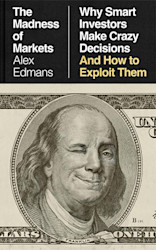
Alex Edmans’ book The Madness of Markets: Why Investors Make Crazy Decisions – and How to Exploit Them is out now.
What drives the stock market? What causes prices to soar one day and crash the next? Why do investors pile in or head for the exits?
The traditional answer is economic fundamentals. The price of a stock is the present value of its future dividends, so it should be driven by anything that affects those dividends. For Apple, that might include the state of the US economy, consumer confidence, reviews of the iPhone relative to Samsung’s products, views on John Ternus as the successor to Tim Cook, and sustainability factors such as Apple’s corporate culture and environmental record.
But stocks swing so violently that it is difficult to believe that fundamentals tell the whole story. Nobel laureate Robert Shiller’s most famous paper was titled Do stock prices move too much to be justified by subsequent changes in dividends? His answer was a resounding yes. When prices rise, the business often has not changed at all – you are simply paying more for the exact same thing. Something else has to be at work.
And that “something else” is investor psychology. The people trading stocks are not robots operating with laser-like precision, taking every relevant piece of information into account in a rational and dispassionate manner. They are humans, driven by sentiment, hype and animal spirits. But showing that sentiment affects the stock market is surprisingly difficult, because many factors that affect sentiment also affect fundamentals.
Discover fresh perspectives and research insights from LBS
“Showing that sentiment affects the stock market is surprisingly difficult, because many factors that affect sentiment also affect fundamentals.”
If the market falls during a pandemic, is that because people are depressed from being locked down, or because the pandemic has damaged economic activity? The same problem arises with elections, plane crashes and natural disasters. They influence our emotions, but they also have real economic effects.
So I looked at international football. Whether a team wins or loses a game has little influence on the economy, but a large impact on mood. When England lost to Argentina in the 1998 World Cup (on penalties, of course), heart attacks shot up over the next few days. Across the pond, suicides rise in Canada when the Montreal Canadiens are eliminated from the ice hockey Stanley Cup. While Canadians kill themselves, Americans kill each other – when a team is knocked out of the NFL play-offs, murders go up in the local city.
Diego García, Øyvind Norli and I studied 1,162 football matches across 39 countries. We found that, after a national team lost, its country’s stock market tended to fall the next trading day – even after stripping out global market movements and other usual drivers of returns. The effect grew with the importance of the match. It was stronger in the World Cup than the European Championship, and stronger in the elimination stages than group games. After a country is knocked out of the World Cup, its national index falls by an average of 0.5% the next day. Applied to the FTSE 100, that’s over £13 billion wiped off the market on a single day.
Why does this matter? You’re unlikely to start a hedge fund trading on football results. But football was never the goal. The goal was to test whether investor sentiment moves stock prices – if so, it opens the door to a whole host of other inefficiencies. If the market responds to something as irrelevant as a football match, what else might it overreact to?
“If the market responds to something as irrelevant as a football match, what else might it overreact to?”
One answer is: non-news. On 15 April 2026, Allbirds – once known for wool trainers – announced that it was becoming NewBird AI. Its shares jumped 582% in a day – even though Allbirds had no clear expertise in artificial intelligence. Trainers are a world away from trained models. The dot-com bubble produced the same trick. A study of 183 companies that added “.com”, “.net” or “Internet” to their names enjoyed an average stock price boost of 74%, even when nothing else changed: no new strategy, no new product, sometimes not even an internet connection.
Markets also overreact to old news. On 3 May 1998, the New York Times featured a potential cancer breakthrough on its front page. The next morning, EntreMed – which produced the drugs – opened at $85, up from $12. But the same breakthrough had been reported five months earlier, including by the New York Times itself. Investors were getting hyped up about something they already knew.
And sometimes the news is real, but the extrapolation is wild. Just like the calls to fire a football manager after a single defeat, investors overreact to small bits of information. The lockdown clearly benefited Zoom, but did it justify its shares soaring over 700%? Rivals such as Microsoft Teams and Google Meet quickly caught up, the world reopened, and people remembered that they quite liked meeting in person. By the end of 2022, Zoom had surrendered almost all its gains.
The first benefit of understanding hype is defensive: you can avoid getting swept up in it yourself. The second is offensive: you can exploit it in others. A famous study shows the power of taking the other side. It sorted US stocks into winners and losers based on their past three-year performance. Over the next three years, the losers beat the winners by 25% – a full-blown reversal of fortune.
This pattern is everywhere. It’s been replicated in 22 other countries, and in bonds and currencies as well as stocks. One paper went back to 1265, the year of the first English Parliament and the peak of the Mongol Empire founded by Genghis Khan. Back then, people traded not SpaceX or NFTs but barley, cheese, eggs, oats, and gold. Over a 750-year period, a contrarian commodity strategy delivered an astonishing 13% per year.
This points to the common culprit: investor psychology. From medieval barley merchants to Gen Z stock traders, we spot trends and chase them too far. In theory, stocks are traded by hyper-rational traders and so the price is always right. In practice, stocks are traded by hype-fuelled humans and so the price is often wrong.
“In practice, stocks are traded by hype-fuelled humans and so the price is often wrong.”
Throughout my 13 years at LBS, I’ve taught the importance of investor psychology in every MBA and MFA lecture, even though it may not seem like a core part of a standard finance course. I take a ten-minute “extracurricular” break to discuss how finance works in the real world, rather than only how textbooks say it should work. But there’s so much fascinating research on behavioural finance that I couldn’t fit it all into my course. So I started a blog, then began sharing it on LinkedIn. Now it’s grown into a new book, The Madness of Markets: Why Smart Investors Make Crazy Decisions — And How to Exploit Them. It’s a cross between the surprising, data-driven discoveries of Freakonomics and the practical investing insights of The Psychology of Money.
But overreaction is only half the story. Sometimes the market barely reacts at all.
Every January, Fortune magazine publishes a list of the 100 Best Companies to Work For in America. It’s front page news, but the stock barely budges. I found that these companies subsequently beat their peers by 2.3-3.8% per year over a 28-year period.
Why? Employee satisfaction is intangible. Many investors value a company based on what they can see – its profits, dividends, and assets – and overlook corporate culture. Other investors go further than ignoring it; they bet against it by viewing an employee-friendly company as fluffy or woke. Others still acknowledge its importance but have no clue how to put camaraderie into cell C23 of a valuation spreadsheet. The same blind spot extends to customer satisfaction, brand, innovation and corporate governance. These factors are public, but public does not mean priced.
Another cause of underreaction is simpler: investors may not even notice the information in the first place. Take TRW Automotive. In 2007, it held its Annual General Meeting in McAllen, Texas – a small town at the southernmost tip of the continental United States. To get there, the CEO would have to fly to Houston and then drive 300 miles through the flat scrubland of southern Texas. Why go through all that trouble? So that shareholders would have to as well. Or wouldn’t – because he didn’t want them to come.
“Another cause of underreaction is simpler: investors may not even notice the information in the first place.”
A clever study found that when companies hold their meetings in remote locations, their stock falls by an average of 6.8% over the next six months. A remote location is a revealing clue that the CEO is nervous about the company and doesn’t want shareholders to ask questions. It’s the equivalent of a poker tell, uncovering what the CEO truly thinks. But because the market focuses on flashy rebrands and compelling narratives, it ignores this information hiding in plain sight.
What does this all mean? Beating the market does not require statistical pyrotechnics or insider information, but understanding investor psychology. It starts with two questions: What are other investors hyping up too much? And what valuable information are they overlooking because they don’t notice it or understand its relevance?
The biggest edge does not always come from more information. Sometimes it comes from seeing more clearly what’s already out there.
The Madness of Markets: Why Smart Investors Make Crazy Decisions – and How to Exploit Them by Alex Edmans is out now